
Unmasking ‘Greenwashing’: What’s Real, What’s Green Marketing, and How to Tell the Difference
6 minute read
For years, buying household products was a simple decision: we looked at the price, whether we liked the scent, and how well it performed. Today, that’s no longer the case. More and more consumers — moms, dads, people with sensitive skin, families seeking to reduce their impact — read labels, research ingredients, and ask what they are truly bringing into their homes.
And in the middle of that search comes a wave of messages: “eco,” “sustainable,” “responsible,” “conscious,” “clean.” Bottles are filled with green tones, illustrated motifs, and appealing promises. But when everything appears responsible, distinguishing what is authentic and real becomes difficult.
It’s understandable to feel confused.
Many consumers want to do the right thing. They want to choose products that work well, that are safer for their families, and that have a lower environmental impact. But they also feel skeptical. Is it a real improvement? Or simply a well-crafted narrative?
That’s where the dilemma around green marketing and so-called “greenwashing” appears.
This isn’t about pointing fingers or oversimplifying a complex topic. It’s about helping people understand that communicating responsibility can be done with rigor… or it can remain surface-level.
🌿 What Is Green Marketing?
Green marketing, at its core, is the communication of a product’s or company’s environmental or wellness benefits. When done well, it serves a positive purpose: it informs, educates, and empowers more thoughtful choices.
A brand may communicate that it uses plant-based ingredients, reduces plastic in its packaging, or manufactures using renewable energy. That is green marketing — when it is supported by facts.
The problem arises when the message exceeds reality. When broad terms are used without explanation. When packaging changes, but the formula does not. When emotions are emphasized without verifiable data.
That’s when marketing stops informing and starts creating confusion.
🚩 Signs of Superficial Marketing
In a message-saturated environment, there are patterns worth noticing:
- General claims without specific details
- Use of environmental symbols without independent certifications
- Lack of transparency about manufacturing or sourcing
- Focus on a minimal improvement while the rest of the product remains unchanged
Real commitment is often less loud — but more consistent.
🌱 What Real Commitment Means
The difference between messaging and action is often found in structural decisions: how something is made, what is prioritized, where investments are directed, and which standards a company chooses to meet.
In the case of ECOS, commitment is neither recent nor opportunistic. It has been part of our DNA and operating model for decades.
🏭 Responsible Manufacturing: Beyond a Promise
When we think about environmental commitment, it’s easy to imagine only the final product. But the real story lies in how — and by whom — that product is made.
At ECOS, sustainability begins at the very heart of the company. Our team is united by an essential mission: to protect the well-being of people, pets, and the planet through more authentic and safer cleaning products. That mission is not a commercial slogan; it has been our reason for being for more than 55 years, since our founder, Van Vlahakis, set out to create a more responsible alternative in an industry traditionally dominated by harsh chemicals.
Today, that vision continues to guide every decision. ECOS operates four sustainable manufacturing facilities in the United States, designed to reduce environmental impact in a comprehensive way. Under the leadership of our CEO, Kelly Vlahakis-Hanks, the company became the first in the world to achieve a unique “trifecta” of certifications for its facilities: carbon-neutral facilities, water-neutral facilities, and TRUE Platinum Zero Waste certification.
You can learn more about our history, mission, and team on our Our People page: 👉 https://www.ecos.com/our-people/
This means every part of the process — from raw material selection to the energy that powers our machines — is designed to reduce footprints and maximize tangible benefits for people and the planet.
Real commitment begins long before a product reaches the shelf. It begins with people and company culture, because we don’t just talk about responsibility — we integrate it into every stage of production.
🧴 Ingredients and Formulas That Truly Make a Difference
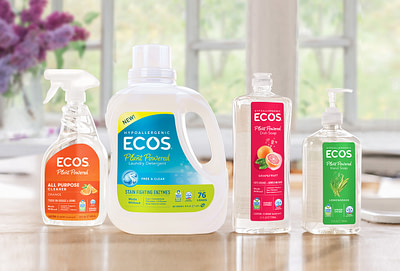
Part of our commitment to transparency and safety lies both in what we do not use and in what we choose to use.
At ECOS, we list every ingredient in each formula — because we believe you have the right to know what products you bring into your home — and we actively work to explore and apply safer and effective ingredients derived from nature.
Our chemists continually seek ways to combine cleaning performance with gentleness and reduced impact. That’s why many of the surfactants used in our products — the ingredients that do the cleaning work — are derived from natural sources such as:
- Coconut (coconut oil, which provides excellent cleaning power and is highly renewable). Fun fact! Did you know each coconut tree can support up to three generations of farmers, with each tree providing roughly 60 years of continuous production?
- Beet (its sugars are transformed into environmentally mindful surfactants)
- Minerals (which help enhance performance, even in hard water)
- Vinegar and other traditional ingredients carefully selected for performance and lower potential impact on health and the environment
In addition, ECOS maintains an evolving list of more than 500 substances that are never used in our products because they do not meet strict criteria for human and environmental safety.
These decisions are not cosmetic; they are the result of a formulation philosophy that prioritizes clarity, proven performance, and lower impact.
You can explore our approach in detail on our Safer Cleaning page: 👉 https://www.ecos.com/en/safer-cleaning/
Our chemists continually work to balance performance and safety, seeking alternatives that meet strict criteria for both human well-being and environmental responsibility.
Because responsible formulation is not a trend — it is an ongoing scientific process.
🏷️ Verifiable Standards: The Safer Choice Label
Having good intentions is positive. Demonstrating that those intentions translate into products that meet strict criteria is another level.
This is where the U.S. Environmental Protection Agency’s (EPA) Safer Choice label comes in. Safer Choice is a recognized program that certifies products that:
- Contain ingredients evaluated and approved for lower risk to human health and the environment
- Meet performance criteria comparable to or better than conventional products
- Integrate progressive packaging and formulation practices
ECOS offers more than 120 Safer Choice certified products — more than any other company — and has been repeatedly recognized as Safer Choice Partner of the Year by the EPA.
This label is not just a badge on a package. It means every ingredient has been rigorously reviewed, the product meets high performance standards, and there is demonstrated commitment to safety beyond marketing language.
A responsible message gains credibility when backed by external standards.
Learn more about this certification here: 👉 https://www.ecos.com/epa-safer-choice-products/
The Safer Choice label is not simply a visual icon. It represents independent scientific review and compliance with rigorous standards.
🤝 Consistency Throughout the Product Life Cycle

Sustainability does not begin or end with packaging.
At ECOS, our approach to sustainability — and to Climate Positive cleaning — means evaluating each product’s impact from initial research through final use and understanding how that product contributes to reducing environmental impact.
This includes actions such as:
- Reducing carbon emissions and operating with 100% renewable energy at all facilities
- Water neutrality and restoring millions of gallons annually in vulnerable habitats
- Diverting more than 99% of plant and office waste away from landfills or incineration
In other words, consistency between what is communicated and what is done exists at every step of production.
Responsibility does not end with the formula or the factory. It extends across the entire product life cycle.
On our Sustainability page 👉 https://www.ecos.com/es/sustainability/ you can learn more about:
- 100% renewable energy in our facilities
- Carbon neutrality
- Water neutrality
- Diverting more than 99% of waste from landfills
- Positive-impact initiatives that help restore natural resources
This comprehensive approach is what we call coherence: aligning product, operations, and values under one standard.
Choosing With Information
To help consumers make informed decisions, the Federal Trade Commission (FTC) developed the Green Guides, a framework that helps brands communicate their environmental benefits clearly and responsibly. Their goal is to prevent greenwashing (when a brand exaggerates or misleads about how “green” its products are) and to ensure that consumers receive accurate and truthful information. While they are not laws themselves, the FTC uses them as a basis to evaluate whether a company is engaging in deceptive advertising, which can lead to enforcement actions. At ECOS, we align our claims with these principles because transparency matters.
Well-executed green marketing informs.
Real commitment transforms.
As a consumer, you do not need to become a chemistry expert. It is enough to ask simple questions:
- Does the brand clearly explain what makes it different?
- Are there verifiable certifications?
- Is there concrete data behind the claims?
- Does the company demonstrate consistency in manufacturing and sustainability?
At ECOS, we believe transparency builds trust. And trust is earned through facts, not just words. Because when commitment is authentic, it does not need exaggeration. It stands on its own.